
Introduction
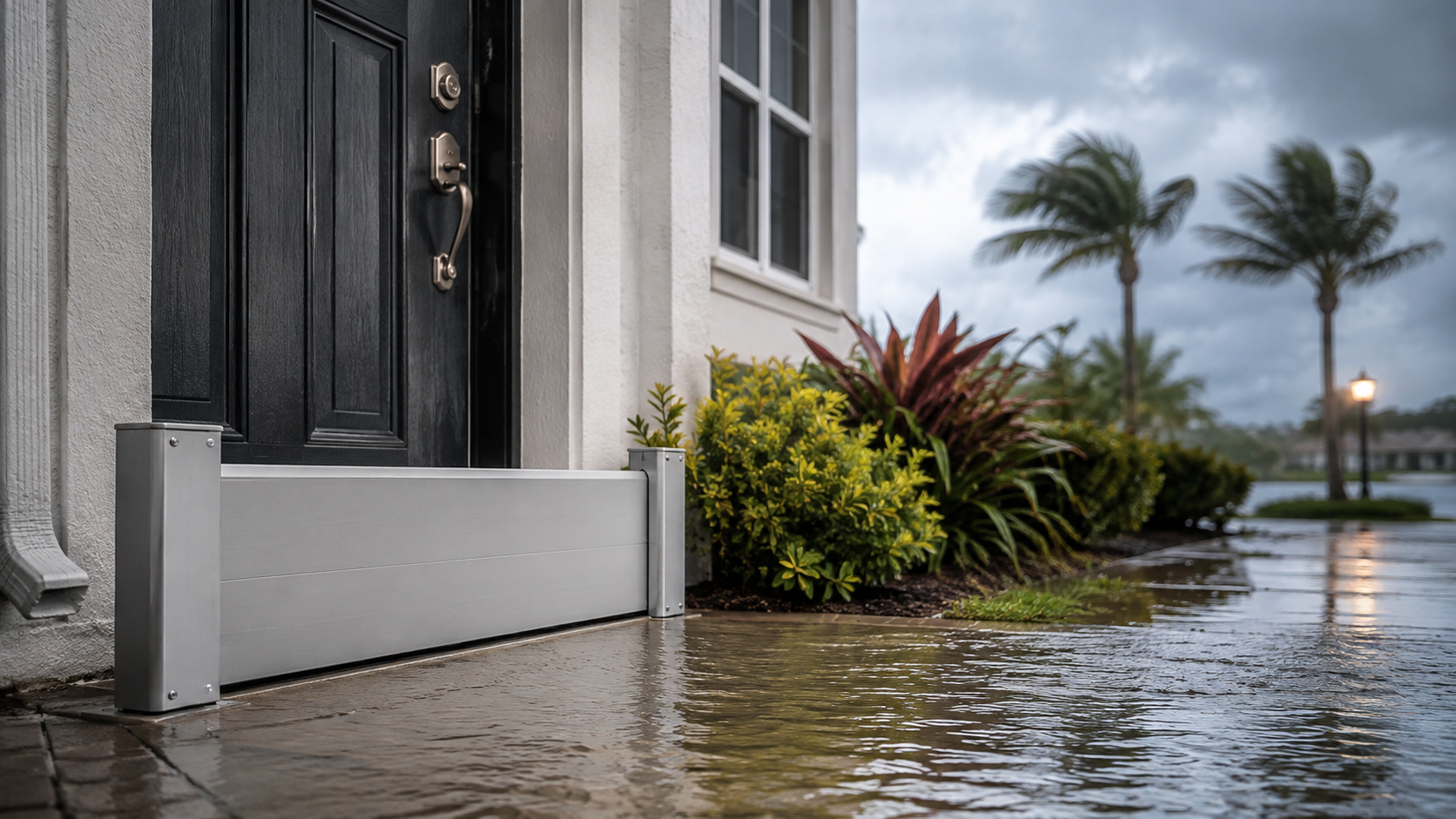
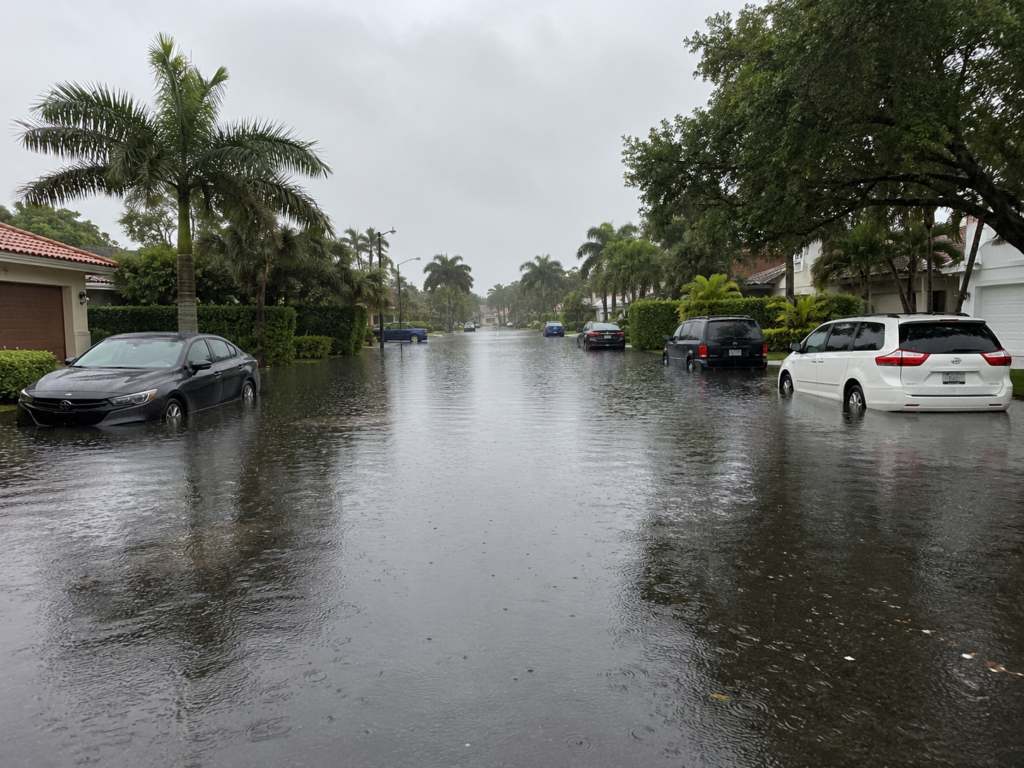
Florida doesn’t need a hurricane to flood. A single afternoon of heavy rainfall can turn a quiet residential street into ankle-deep water within an hour no storm name required. That’s the part most homeowners don’t fully grasp until it happens to them: flooding in Florida comes from four different directions, and only one of them is the hurricane itself.
There’s storm surge, the wall of ocean water a hurricane pushes onto the coast, capable of rising several feet in a matter of hours. There’s flash flooding, driven by the sheer intensity of tropical rainfall overwhelming drainage systems faster than they can clear. There’s plain heavy rainfall flooding, which doesn’t need a named storm at all just Florida’s routine summer thunderstorm pattern sitting over the wrong neighborhood for too long. And there’s urban flooding, a problem unique to how flat, low-lying, and heavily paved much of the state is, where storm-water simply has nowhere to go.
This matters because the flood barrier you choose has to match the type of water you’re actually facing not just “a flood” in the abstract. A product built to hold back a slow-rising storm surge behaves very differently under a garage door than a product designed to stop water seeping under a front door during a rainstorm. Understanding that distinction, before you buy anything, is the single biggest factor in whether your flood protection actually works when you need it.
The good news: by the time you finish this guide, you’ll know exactly which barrier fits which situation sand-less sandbags, traditional sandbags, flood socks, or door dams and why the “best” one isn’t the same for every Florida home.
Why Flooding Is Becoming a Bigger Problem in Florida
Florida’s flood risk isn’t static it’s compounding. Several overlapping trends are pushing more homes into flood exposure every year, including homes that have never flooded before:
- Storm surge intensity: coastal storm surge events are pushing farther inland than older flood maps account for, especially in low-lying counties.
- Flash flood frequency: short, intense rainfall bursts are increasingly overwhelming drainage systems designed for an earlier climate baseline.
- Coastal flooding at high tide: so-called “sunny day flooding” now affects some coastal streets even without a storm present, simply from elevated sea levels at peak tide.
- Inland flooding: counties well away from the coast are seeing river and retention-pond overflow events from rainfall runoff, not surge.
- Urban drainage limitations: much of Florida was developed on flat terrain with storm-water systems that struggle to keep pace with both rainfall intensity and continued paving/development upstream.
Flood Source Comparison
| Flood Type | Primary Cause | Typical Warning Time | Water Behavior |
|---|---|---|---|
| Storm Surge | Hurricane pushing ocean water inland | Hours to 1–2 days | Rises steadily, can be several feet deep |
| Flash Flooding | Intense short-duration rainfall | Minutes to hours | Rises fast, often recedes fast |
| Heavy Rainfall Flooding | Sustained thunderstorms/tropical rain | Hours | Gradual rise, can linger |
| Urban/Drainage Flooding | Overwhelmed storm-water systems | Minutes to hours | Pools in low spots, streets, garages |
Why Flood Barriers Matter More Than Ever
Quick Answer Box
A flood barrier’s job isn’t just to stop water from entering it’s to prevent the cascade of damage that starts the moment water touches drywall, flooring, or electrical systems. Even a few inches of water intrusion can trigger thousands of dollars in repairs and weeks of disruption.
Once water gets past a threshold, the damage compounds quickly:
- Property damage: flooring, drywall, baseboards, and furniture can be ruined by water that never even reaches ankle height.
- Water intrusion into wall cavities: water that enters low often wicks upward inside walls, well beyond the visible waterline.
- Mold growth: Florida’s heat and humidity mean mold can begin forming within 24–48 hours of water exposure, often before homeowners return to assess damage.
- Insurance complications: many standard homeowners policies exclude flood damage entirely, meaning uninsured losses from something a $50–$150 barrier could have prevented.
- Cleanup costs: professional water extraction, drying, and mold remediation frequently costs far more than the flood barrier itself.
- Business downtime: for commercial properties, even minor flooding can mean days of closure and lost revenue while repairs are underway.
Key Takeaways
- Flood barriers are a prevention cost, not a repair cost and prevention is almost always cheaper.
- Even shallow water intrusion can trigger disproportionately expensive damage.
- The right barrier, deployed in time, is often the difference between “inconvenience” and “insurance claim.”
The History of Sandbags
Definition Box
Sandbag: A woven bag, traditionally burlap or polypropylene, filled with sand and stacked to create a temporary barrier that blocks or redirects moving water.
Sandbags have been used for flood and erosion control for well over a century, originally adopted for military fortification before becoming the default civilian flood-defense tool. Their appeal was always simplicity: sand is heavy, widely available, and once bagged and stacked creates a barrier dense enough to slow or stop shallow water flow.
Military engineers used sandbags to reinforce trenches and fortifications long before they became a flood-control staple, and that same principle stacked mass creating a barrier carried directly over into civilian disaster response. Sandbags remain a fixture at municipal distribution sites before major storms for a simple reason: they don’t require any technology, just labor and material.
Despite decades of newer alternatives entering the market, many Florida homeowners still default to sandbags today, largely out of familiarity and because local governments frequently distribute them for free before storms.
Pros & Cons Box
| Pros | Cons |
|---|---|
| Widely available, often free from local government | Requires sand, shovels, and physical labor |
| Familiar, low-tech, no learning curve | Heavy difficult for elderly or mobility-limited residents |
| Effective at slowing shallow, low-pressure water | Time-consuming to fill and stack under time pressure |
| Low cost per bag | Degrades over time, becomes unusable after one use |
How Traditional Sandbags Work
Traditional sandbags rely on mass and friction, not technology. A properly filled and stacked sandbag wall works by creating enough weight and surface contact to resist the pressure of moving or pooling water but that effectiveness depends heavily on how the bags are filled, stacked, and maintained.
Installation: Bags are typically filled about half to two-thirds full (overfilling makes them harder to stack tightly), then laid in overlapping rows like bricks, with each layer offsetting the seams of the layer below to reduce gaps.
Weight: A properly filled sandbag typically weighs 35–40 pounds, which is part of what makes it effective and part of what makes it physically demanding to deploy in volume.
Effectiveness: Sandbags perform reasonably well against slow-moving, shallow water (a few inches to roughly a foot), but they are not airtight or fully waterproof water can still seep through gaps between bags and through the bag material itself over time.
Labor required: Filling and stacking enough sandbags to protect a single doorway can take one or two people 30–60 minutes; protecting an entire ground floor perimeter can take hours and multiple people.
Storage: Empty sandbags store compactly, but filled sandbags are bulky, heavy, and impractical to store pre-built for long periods.
Disposal: Once used, wet sand often becomes contaminated with floodwater runoff and may require special disposal rather than reuse an overlooked cost and hassle factor.
Comparison Table: Traditional Sandbag Snapshot
| Factor | Traditional Sandbag |
|---|---|
| Deployment Time (per barrier point) | 30–60+ minutes |
| Weight (filled) | 35–40 lbs each |
| Reusable | No — typically single-use |
| Labor Intensity | High |
| Best For | Slow-rising, shallow water; longer warning windows |
Pros & Cons
| Pros | Cons |
|---|---|
| Inexpensive per bag | Labor- and time-intensive to deploy |
| No special equipment needed to use | Requires sand source and shovel |
| Effective against shallow, slow water | Not reusable; disposal can be a hassle |
| Widely understood, no instructions needed | Physically demanding, difficult for some residents |
Expert Insight: Emergency management professionals consistently note that the biggest failure point for traditional sandbags isn’t the material it’s timing. Because filling and stacking take real time and labor, sandbags deployed under last-minute pressure are often stacked too loosely or too late to be fully effective.
Modern Flood Protection Solutions
Sandbags solved one problem mass to block water but they were never built for speed. As flood events have become more frequent and warning windows have gotten shorter, homeowners and businesses have pushed for something sandbags were never designed to offer: fast deployment, clean storage, and re-usability. That demand has produced a new generation of flood barriers sand-less sandbags, flood socks, and door dams each solving the “sandbag problem” from a different angle. None of them replace sandbags in every scenario, but each closes a specific gap that traditional sandbags leave open.
sand-less Sandbags
Quick Answer Box
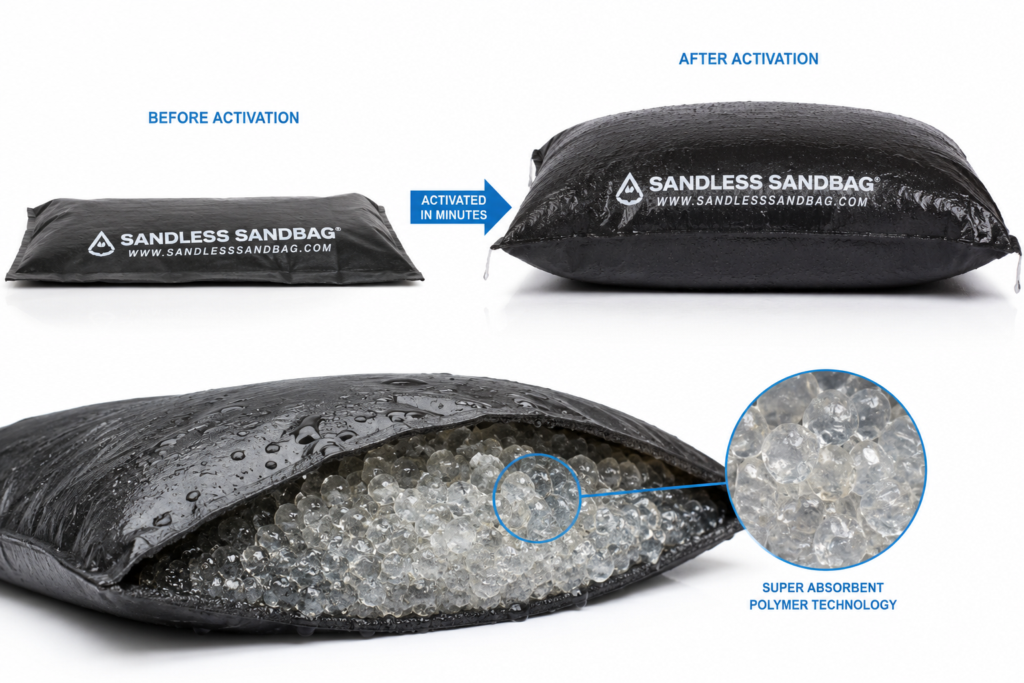
sand-less sandbags use a super-absorbent polymer core that expands on contact with water, creating a barrier similar in function to a sand-filled bag without the sand, the shovel, or the labor.
How they work: The bag’s shell contains a super-absorbent polymer. Submerged in water for a few minutes, the polymer absorbs the water and swells, turning a flat, lightweight pouch into a firm, stack-able barrier.
Materials used: A woven or non-woven outer shell holds the absorbent polymer core; the shell is engineered to resist tearing once expanded and saturated.
Advantages:
- Ship and store flat a single pallet can hold hundreds of dry bags versus a fraction as many pre-filled sandbags
- Activate in minutes with no shovel, sand source, or crew required
- Expand into a uniform shape that stacks more predictably than lumpy, hand-filled sand
- Manageable weight for elderly or mobility-limited residents to handle before activation
Limitations:
- Higher cost per unit than an empty sandbag shell
- Cannot be “undone” once activated no draining back to a flat, reusable state
- Requires several minutes of water exposure to fully activate, so they’re not truly instant
Best use cases: Fast-forming flash floods, residents who can’t handle heavy manual labor, and situations where storage space is limited until the moment a barrier is actually needed.
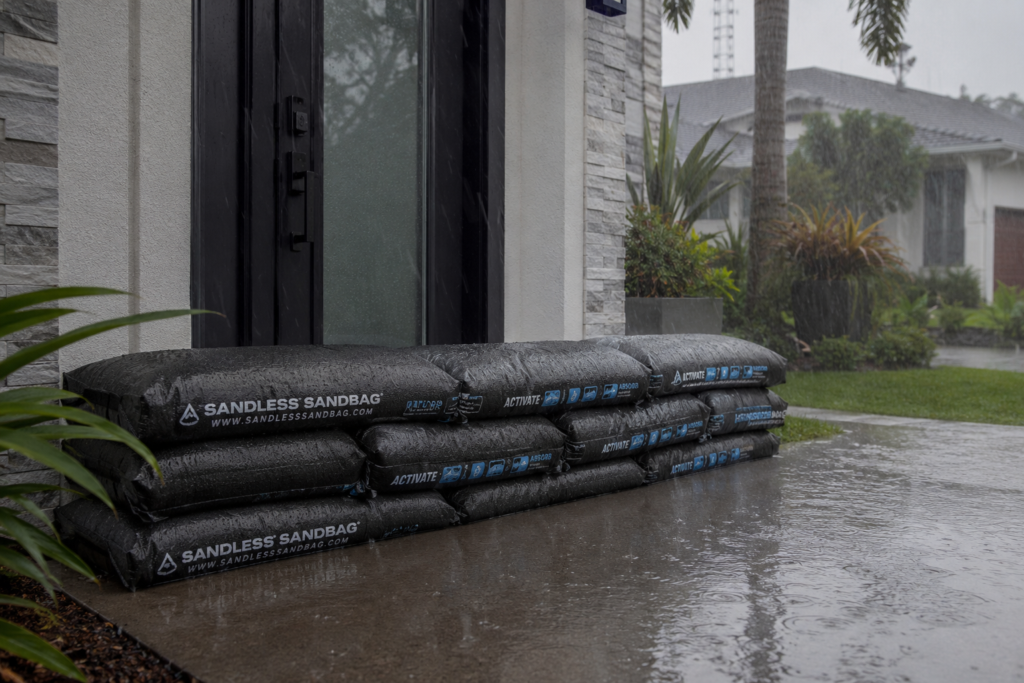
Residential use: Ideal for garage doors, front entries, and sliding doors where a resident needs to move quickly without a filling operation.
Commercial use: Well suited to retail storefronts and offices that need to protect multiple entry points quickly without a labor crew on standby.
Florida-specific recommendation: Because Florida flash floods and storm-adjacent rain events often leave only a short activation window, having sand-less sandbags pre-staged and ready to submerge is generally more practical for coastal and urban Florida households than relying on last-minute sand runs.
Pros & Cons
| Pros | Cons |
|---|---|
| Rapid deployment, minimal labor | Higher per-unit cost than plain sand |
| Compact, space-efficient storage | Needs several minutes to activate |
| Manageable weight before activation | Single-use once fully saturated |
| Uniform, stable stacking shape | Not ideal for very deep or fast-moving water |
Expert Tip: Pre-position sand-less sandbags near vulnerable entry points before a storm watch is issued activation still takes several minutes, and that’s time you won’t have once water is already approaching the door.
Flood Socks
Construction: Flood socks are long, tube-shaped barriers filled with an absorbent material (often a super-absorbent polymer or dense fiber core) encased in a flexible, water-resistant outer sleeve.
Water absorption: The absorbent core soaks up water on contact, causing the sock to swell and conform tightly along its length which allows it to seal against uneven or irregular surfaces better than a stack of rigid units.
Performance: Flood socks excel at sealing long, continuous gaps thresholds, garage door bottoms, and baseboards because their flexible shape molds to the contour of the floor rather than leaving gaps between separate units.
Advantages:
- Conforms to uneven or irregular flooring and thresholds
- Lightweight and easy to position before activation
- Good for sealing long horizontal gaps in a single continuous piece
Limitations:
- Less effective for tall or high-volume water compared to stacked barriers
- Generally single-use once fully saturated, similar to sand-less sandbags
- Not designed to bear significant standing water pressure over large vertical heights
Ideal situations: Garage door bottoms, sliding glass doors, low thresholds, and gaps where water is more likely to seep in a thin, spread-out line rather than surge as a wall.
Indoor vs outdoor use: Flood socks are commonly used both outdoors (garage entries, exterior doors) and indoors (sealing interior door gaps as a secondary containment layer if water has already breached an outer barrier).
Pros & Cons
| Pros | Cons |
|---|---|
| Conforms to uneven surfaces and gaps | Limited effectiveness against deep or fast water |
| Lightweight, easy to position | Typically single-use per saturation |
| Good for long, low thresholds | Less structural height than stacked barriers |
| Works well as secondary indoor containment | Not a substitute for full-height barriers in high-surge zones |
Door Dams
How door dams work: Door dams are rigid or semi-rigid panels often metal, aluminum, or heavy-duty polymer that fit directly across a doorway opening, sealing against the frame with gaskets or clamps rather than relying on absorbent material.
Installation: Most door dams are custom- or standard-sized to fit a specific doorway width, secured with brackets, clamps, or a track system mounted to the door frame, then sealed along the base and sides.
Best applications: Single, well-defined openings front doors, garage doors, and commercial storefront entries where the barrier needs to hold a consistent seal against a specific width and height of opening rather than an irregular surface.
Limitations:
- Requires accurate measurement of the doorway in advance; a poor fit undermines the seal
- Typically a higher upfront cost than sand-less sandbags or flood socks
- Not easily adapted to protect multiple, differently sized openings without multiple units
Maintenance: Because door dams are reusable, they require periodic inspection of seals, gaskets, and mounting brackets to confirm the barrier will seal properly the next time it’s needed a maintenance step absorbent-based barriers don’t require.
Expert Recommendation: Door dams are best suited to homeowners or businesses with a known, recurring flood risk at a specific entry point the upfront cost and installation effort pay off over repeated use, but they’re a poor fit for anyone facing an unpredictable, first-time flood threat with no time to measure and fit a panel.
Other Modern Flood Barriers
Water-Activated Barriers: A broader category that includes sand-less sandbags and flood socks any product using absorbent polymer technology to expand on contact with water. Best used where speed and simplicity matter more than long-term re-usability.
Inflatable Flood Barriers: Air- or water-filled tubes that can be rapidly deployed and inflated to create a barrier wall, often used for longer perimeter protection around a property rather than a single doorway. Best suited to properties needing to cover extended distances quickly, such as larger commercial sites.
Reusable Flood Barriers: Rigid, modular panel systems (similar in concept to door dams but often scalable to longer runs) designed for repeated deployment over many flood seasons. Best suited to businesses or homeowners in chronically flood-prone locations where the barrier will be used multiple times per year, making the higher upfront investment worthwhile over time.
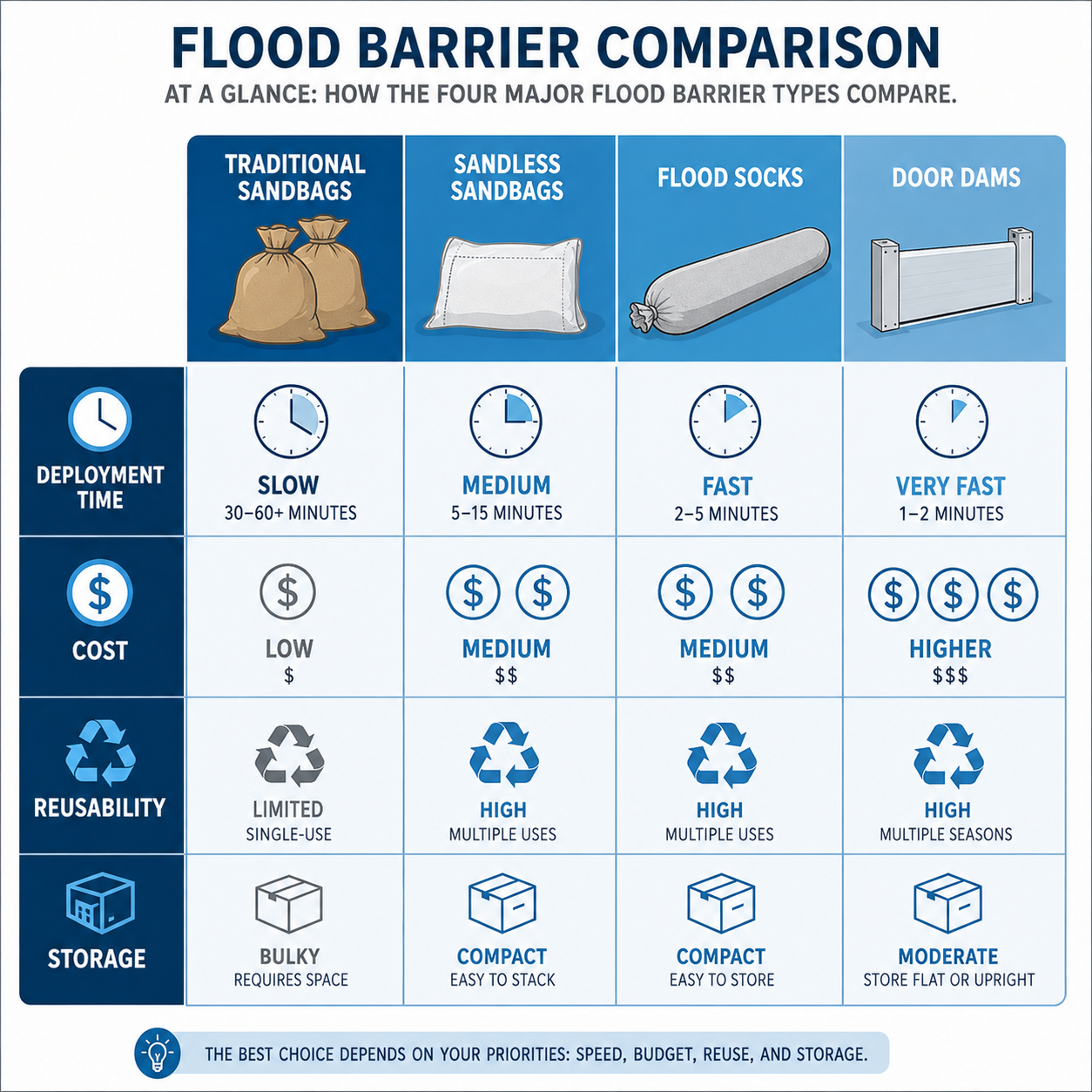
Comparison Tables
1. Traditional Sandbags vs sand-less Sandbags
| Factor | Traditional Sandbags | sand-less Sandbags |
|---|---|---|
| Deployment Time | 30–60+ min | 5–10 min (incl. activation) |
| Labor Required | High | Low |
| Weight (ready to use) | 35–40 lbs | ~30–35 lbs (after activation) |
| Reusable | No | No |
| Storage (dry) | Bulky if pre-filled | Very compact |
2. Sandbags vs Flood Socks
| Factor | Sandbags | Flood Socks |
|---|---|---|
| Best For | Broad, stacked barriers | Long, low thresholds |
| Conforms to Surface | Poorly (gaps between bags) | Well (flexible shape) |
| Setup Speed | Slow | Fast |
| Height of Protection | Moderate (stack-able) | Low to moderate |
3. Sandbags vs Door Dams
| Factor | Sandbags | Door Dams |
|---|---|---|
| re-usability | No | Yes |
| Upfront Cost | Low | Higher |
| Fit Precision | Loose, gap-prone | Custom, tight seal |
| Setup Time | Slow | Fast (once installed/measured) |
4. sand-less Sandbags vs Flood Socks
| Factor | sand-less Sandbags | Flood Socks |
|---|---|---|
| Shape | Rectangular, stack-able | Long, tube-shaped |
| Best Application | Doorways, openings | Thresholds, uneven gaps |
| Activation Time | ~5 minutes | Similar, on contact |
| Stacking Height | Moderate | Low |
5. Flood Socks vs Door Dams
| Factor | Flood Socks | Door Dams |
|---|---|---|
| Reusable | No | Yes |
| Fit Flexibility | Adapts to any gap shape | Fixed to measured opening |
| Cost | Lower | Higher |
| Best Use | Irregular surfaces | Defined single doorway |
6. Cost Comparison
| Barrier Type | Relative Cost |
|---|---|
| Traditional Sandbags | $ (lowest per bag, excludes labor/sand) |
| sand-less Sandbags | $$ |
| Flood Socks | $$ |
| Door Dams | $$$ (higher upfront, reusable) |
7. Deployment Time
| Barrier Type | Approx. Time to Deploy |
|---|---|
| Traditional Sandbags | 30–60+ minutes |
| sand-less Sandbags | 5–10 minutes |
| Flood Socks | 5–10 minutes |
| Door Dams | 10–20 minutes (pre-installed track) |
8. Storage Space
| Barrier Type | Storage Footprint |
|---|---|
| Traditional Sandbags (empty) | Compact |
| sand-less Sandbags | Very compact |
| Flood Socks | Compact |
| Door Dams | Larger (rigid panels) |
9. re-usability
| Barrier Type | Reusable? |
|---|---|
| Traditional Sandbags | No |
| sand-less Sandbags | No |
| Flood Socks | No |
| Door Dams | Yes |
10. Flood Protection Effectiveness
| Barrier Type | Shallow, Slow Water | Deep or Fast Water |
|---|---|---|
| Traditional Sandbags | Good | Moderate |
| sand-less Sandbags | Good | Moderate |
| Flood Socks | Good (low gaps) | Weak |
| Door Dams | Good | Good (properly sealed) |
11. Cleanup Requirements
| Barrier Type | Cleanup Effort |
|---|---|
| Traditional Sandbags | High (wet sand disposal) |
| sand-less Sandbags | Moderate (disposal after use) |
| Flood Socks | Moderate |
| Door Dams | Low (rinse and store) |
12. Maintenance Requirements
| Barrier Type | Ongoing Maintenance |
|---|---|
| Traditional Sandbags | None (single-use) |
| sand-less Sandbags | None (single-use) |
| Flood Socks | None (single-use) |
| Door Dams | Periodic seal/bracket inspection |
13. Environmental Impact
| Barrier Type | Consideration |
|---|---|
| Traditional Sandbags | Sand/bag disposal, potential contamination |
| sand-less Sandbags | Polymer disposal after single use |
| Flood Socks | Similar single-use disposal |
| Door Dams | Lower long-term waste (reusable) |
14. Best Use Cases
| Barrier Type | Best Fit |
|---|---|
| Traditional Sandbags | Longer warning windows, large perimeters, free municipal supply |
| sand-less Sandbags | Fast-forming floods, limited storage, mobility concerns |
| Flood Socks | Uneven thresholds, garage door bottoms |
| Door Dams | Recurring flood risk at a known, single entry point |
15. Florida Weather Suitability
| Barrier Type | Fit for Florida Conditions |
|---|---|
| Traditional Sandbags | Workable but slow for fast-forming flash floods |
| sand-less Sandbags | Strong fit — compact storage suits limited garage/closet space |
| Flood Socks | Strong fit for garage doors, common in FL home design |
| Door Dams | Strong fit for repeat storm-surge-prone coastal properties |
Which Flood Barrier Should You Choose?
Decision Matrix
| Situation | Recommended Barrier |
|---|---|
| Homeowners with limited storage space | sand-less sandbags |
| Renters (no permanent modifications allowed) | sand-less sandbags or flood socks |
| Condo owners protecting a single unit entry | Flood socks or sand-less sandbags |
| Businesses with one main entrance and repeat flood risk | Door dams |
| Warehouses with large loading-dock openings | Inflatable or reusable flood barriers |
| Retail stores needing fast, low-labor setup | sand-less sandbags |
| Property managers covering multiple units | sand-less sandbags (scalable, easy to stock) |
| Schools (limited staff availability during storms) | sand-less sandbags or flood socks |
| Hospitals (mobility and speed both critical) | sand-less sandbags, supplemented by door dams at main entries |
Buying Guide
Choosing the right flood barrier comes down to weighing six practical factors against your specific property and risk profile:
- Budget: Traditional sandbags are cheapest per unit but carry hidden labor and sand costs; door dams cost more upfront but pay off with reuse over multiple seasons.
- Flood Risk: A property with a single recurring flood point (e.g., one low garage entry) benefits from a targeted solution like a door dam, while a property facing unpredictable, varied flood threats benefits from the flexibility of sand-less sandbags.
- Storage Space: Homes and businesses with limited storage should prioritize compact, dry-stored options like sand-less sandbags over pre-filled sandbags or bulky rigid panels.
- Ease of Installation: Time-pressured households should favor barriers with minimal setup steps sand-less sandbags and flood socks both activate in minutes with no tools required.
- re-usability: If flooding is a recurring, near-annual concern, the higher upfront cost of a reusable door dam or panel system is usually justified over repeated single-use purchases.
- Protection Level: Match the barrier to the water type expected shallow, slow water is manageable with absorbent barriers, while deeper or faster water calls for the tighter seal a door dam provides.
Common Mistakes Homeowners Make When Preparing for Flooding
Even well-intentioned homeowners repeatedly fall into the same handful of traps when it comes to flood preparation and most of them have nothing to do with the barrier itself.
Waiting until the last minute. By the time a flood warning is active, sand-less sandbags may be sold out locally, sand distribution lines can stretch for hours, and door dams can’t be measured and fitted properly under time pressure.
Buying the wrong flood barrier. A homeowner facing a long, low garage threshold who buys stack-able sandbags instead of a flood sock often ends up with gaps water simply flows through.
Incorrect installation. Loosely stacked sandbags, an unsealed door dam edge, or a flood sock positioned a few inches off the true low point of a threshold can all quietly defeat an otherwise good product.
Ignoring weak entry points. Homeowners often focus entirely on the front door while overlooking garage doors, sliding glass doors, and low basement or ground-level windows all common water entry points.
Poor storage. Barriers stored in a way that keeps them exposed to moisture, pests, or sun damage may fail or under-perform exactly when needed.
Buying cheap products. Bargain flood barriers made with thin shells or low-grade absorbent material can tear, leak, or fail to reach full expansion false economy when the stakes are water damage.
Forgetting the garage. Garage doors are often the largest, lowest, and least sealed entry point on a home, yet they’re frequently the last thing homeowners think to protect.
Ignoring back doors. Rear and side entrances are addressed far less often than front doors, despite being equally vulnerable.
Not protecting utilities. Exterior HVAC units, electrical panels, and water heaters at ground level are rarely included in flood planning, even though water damage to these systems is often the most expensive to repair.
✔ Common Mistakes Box
| Mistake | Why It Matters |
|---|---|
| Waiting until a warning is issued | Products sell out, installation is rushed |
| Wrong barrier for the entry type | Gaps or poor seal let water through anyway |
| Loose or rushed installation | Undermines even a good product |
| Skipping garage/back doors | These are often the largest vulnerability |
| Cheap, low-quality barriers | Tear, leak, or fail to fully expand |
| No utility protection | Leads to the most expensive repair category |
✔ Expert Tip: Walk your property’s exterior specifically looking for the lowest points not just the most obvious doors since water always finds the lowest entry point first, regardless of which door looks most “important.”
Florida-Specific Recommendations
Coastal Homes: Prioritize storm-surge-rated protection at ground-level entries; door dams or reusable panel systems are often worth the investment given repeat exposure.
Inland Homes: Flash flooding and drainage overflow are the bigger risk here sand-less sandbags and flood socks, which deploy quickly with short warning, are typically the better fit.
Condominiums: Focus on unit-level entry points and coordinate with the HOA on shared spaces like parking garages and lobbies, which fall outside any individual owner’s control.
Apartments: Renters should favor non-permanent solutions sand-less sandbags and flood socks since door dams often require modifications not permitted under a lease.
Businesses: A single, well-known flood-prone entrance (loading dock, main entry) is often best served by a reusable, precisely fitted barrier rather than single-use products purchased repeatedly.
Retail Stores: Fast, low-labor deployment matters most, since store staff not trained crews are usually the ones responsible for setup during business hours.
Warehouses: Large openings and loading docks typically call for inflatable or reusable barrier systems capable of covering wider spans than a single doorway product.
Schools: Limited staff availability during storm windows makes low-labor, fast-deployment barriers (sand-less sandbags, flood socks) the more realistic choice.
Hospitals: Speed and reliability are critical; a layered approach door dams at main entries plus sand-less sandbags at secondary points provides redundancy for a facility that cannot afford failure.
✔ Expert Recommendation Box: No single barrier type is “best” across all of Florida the right choice depends more on your flood type (surge, flash, drainage) and property layout than on brand or product category alone.
HOA and Condo Flood Protection Considerations
Flood protection in a condo or HOA community is rarely a purely individual decision. Several factors are shared, not personal:
- Shared property responsibility. Common areas, lobbies, and parking structures are typically the HOA’s responsibility to protect, not any single owner’s but individual units still need their own entry-point protection.
- Entry points. Unit owners should confirm whether their front door, patio, or balcony sliding door falls under HOA-maintained common structure or individual owner responsibility.
- Parking garages. Below-grade or ground-level parking garages are often the single largest flood vulnerability in a condo building, and protecting them typically requires HOA-level coordination and equipment, not individual barriers.
- Common areas. Lobbies, mail-rooms, and shared hallways benefit from centrally stored, HOA-managed flood barriers rather than relying on individual residents.
- Rules homeowners should check. Before purchasing any barrier, confirm the HOA’s stance on modifications to shared doorways, storage of flood equipment in common areas, and whether the association already maintains barriers for shared spaces.
Flood Barrier Maintenance Guide
Inspection: Check reusable barriers (door dams, panel systems) each season for seal integrity, bracket corrosion, and gasket wear before storm season begins.
Cleaning: Rinse and dry reusable barriers after each use to prevent mold, mildew, or material degradation from residual floodwater.
Storage: Store unactivated sand-less sandbags and flood socks in a dry, enclosed space a garage shelf or closet away from prolonged sun exposure or moisture that could degrade the absorbent core before use.
Replacement: Single-use barriers (sand-less sandbags, flood socks, traditional sandbags) should be replaced after each activation; reusable barriers should be replaced when seals, gaskets, or structural components show visible wear.
Seasonal Maintenance: Perform a full inventory check at the start of hurricane season confirming quantities, expiration status, and storage condition of all flood barriers on hand.
Off-Season Storage: During the off-season, keep barriers in their original packaging where possible, in a climate-stable area, to preserve absorbent material integrity for when they’re needed again.
Emergency Flood Preparation Timeline
72 Hours Before Storm
Review your flood barrier inventory, confirm quantities match your entry points, and purchase or replace anything missing or expired.
48 Hours Before Storm
Clear storm drains and gutters near your property, and stage barriers near the entry points where they’ll be deployed.
24 Hours Before Storm
Begin activating water-activated barriers (sand-less sandbags, flood socks) if flooding is expected within the next day, and confirm door dam measurements/fit one final time.
12 Hours Before Storm
Complete full barrier deployment at all identified entry points, including garage doors and secondary entrances.
6 Hours Before Storm
Do a final walk-around to confirm every barrier is properly seated, and move valuables away from ground-level areas as a backup precaution.
During Storm
Avoid going outside to adjust barriers once conditions become dangerous trust the preparation completed beforehand.
After Storm
Inspect barriers for damage before removal, document any water intrusion for insurance purposes, and begin drying any affected areas promptly to limit mold risk.
Printable Flood Preparation Checklist
- Inventory all flood barriers and confirm expiration/condition
- Identify every ground-level entry point (front, back, garage, sliding doors)
- Match barrier type to each entry point’s shape and flood risk
- Clear gutters and storm drains near the home
- Stage barriers near their deployment points
- Activate water-activated barriers with enough lead time
- Confirm door dam or panel fit and seal integrity
- Protect ground-level utilities and electrical panels
- Move valuables away from ground-level flood risk zones
- Photograph property condition before the storm for insurance records
- Confirm HOA/shared-area flood protection status (if applicable)
- Complete final walk-around before conditions deteriorate
Frequently Asked Questions
1. What is the best flood barrier for a Florida home?
It depends on your flood risk and entry points. sand-less sandbags suit fast-forming floods and limited storage, flood socks fit uneven thresholds, and door dams suit homes with a known, recurring flood point at a single doorway.
2. Are sand-less sandbags as effective as traditional sandbags?
Yes, once activated, sand-less sandbags perform comparably to traditional sandbags for shallow, slow-moving water, while offering faster deployment and easier storage.
3. How long do sand-less sandbags take to activate?
Most sand-less sandbags fully expand within about five minutes of water submersion, though full firmness can take slightly longer depending on the product.
4. Can sand-less sandbags be reused?
No. Once fully saturated and expanded, sand-less sandbags are generally single-use and should be disposed of after the flood event.
5. How much do sand-less sandbags cost compared to regular sandbags?
sand-less sandbags typically cost more per unit than an empty sandbag shell, but when factoring in sand, labor, and time, the total cost gap narrows considerably.
6. Do I need a shovel for sand-less sandbags?
No. sand-less sandbags require only water for activation no sand, shovel, or filling process is needed.
7. What are flood socks used for?
Flood socks are best for sealing long, low, or uneven gaps such as garage door bottoms and thresholds where their flexible shape conforms better than rigid barriers.
8. Can flood socks be used indoors?
Yes, flood socks are commonly used indoors as a secondary containment layer around interior doorways if an outer barrier is breached.
9. How effective are door dams against storm surge?
Door dams can be effective against moderate storm surge when properly measured, installed, and sealed, but effectiveness depends heavily on installation precision.
10. Are door dams reusable?
Yes, door dams are designed for repeated use across multiple flood seasons, unlike single-use absorbent barriers.
11. How do I measure my door for a door dam?
Measure the exact width and height of the opening, including the threshold, and check for any irregularities in the frame that could affect the seal.
12. What’s the difference between a flood sock and a sand-less sandbag?
Flood socks are long and tube-shaped for sealing continuous gaps, while sand-less sandbags are shorter, rectangular units better suited for stacking across an opening.
13. Do traditional sandbags expire?
The bags themselves can degrade over time in storage, particularly if exposed to sunlight or moisture, so periodic inspection is recommended even before use.
14. How many sandbags do I need for a doorway?
This varies by doorway width and desired barrier height, but a typical single doorway often requires a dozen or more properly stacked bags for adequate coverage.
15. Does homeowners insurance cover flood damage?
Standard homeowners insurance often excludes flood damage; separate flood insurance is typically required to cover water intrusion from flooding specifically.
16. What is storm surge?
Storm surge is the rise in ocean water level pushed onto the coast by a hurricane’s winds, capable of causing significant coastal flooding beyond normal tide levels.
17. What’s the difference between storm surge and flash flooding?
Storm surge originates from ocean water pushed inland by a storm, while flash flooding results from intense rainfall overwhelming drainage capacity, regardless of coastal proximity.
18. How much water can flood barriers actually stop?
Most residential flood barriers are designed for shallow to moderate water levels (a few inches to roughly a foot); deep or fast-moving water may exceed their effective capacity.
19. Should renters buy flood barriers?
Yes, non-permanent options like sand-less sandbags and flood socks are well suited to renters since they require no structural modification to the property.
20. Can flood barriers prevent all water damage?
No barrier guarantees complete protection; flood barriers reduce risk and slow water intrusion but should be paired with other precautions like protecting valuables and utilities.
21. Where should I store flood barriers between storms?
Store them in a dry, enclosed space such as a garage or closet, away from prolonged moisture or sun exposure that could degrade materials.
22. How often should I replace my flood barriers?
Single-use barriers should be replaced after each activation; reusable barriers should be replaced when seals or structural components show visible wear.
23. Do I need different barriers for the garage versus the front door?
Often yes garage doors are typically wider and lower, which may call for a different barrier type or quantity than a standard front door opening.
24. What is urban flooding?
Urban flooding occurs when storm-water drainage systems are overwhelmed by rainfall faster than they can process it, common in flat, heavily paved areas.
25. How far in advance should I prepare flood barriers?
Ideally, barriers should be inventoried and staged 48–72 hours before a storm’s expected arrival, well before activation is needed.
26. Can businesses use the same flood barriers as homeowners?
Yes, though businesses with larger openings like loading docks may need commercial-scale solutions such as inflatable or reusable panel systems.
27. What should HOAs consider for flood protection?
HOAs should address shared spaces like parking garages and lobbies separately from individual unit protection, and clarify which areas fall under association responsibility.
28. Is it better to buy sandbags or rent flood protection equipment?
For one-time or infrequent flood risk, purchasing single-use barriers is usually more practical; for chronic, repeat flood exposure, investing in reusable equipment tends to be more cost-effective over time.
29. What’s the biggest mistake people make with flood barriers?
Waiting until a storm warning is active to purchase, install, or activate barriers, which leaves little to no margin for error or product shortages.
30. Do flood barriers help with insurance claims?
While barriers don’t guarantee a claim outcome, documented preventive measures can support a claim and, in some cases, reduce the extent of damage that must be claimed at all.
Key Takeaways
- Florida flooding comes from multiple distinct sources storm surge, flash flooding, heavy rainfall, and urban drainage overflow and the right barrier depends on which one you’re facing.
- Traditional sandbags remain low-cost and effective but demand significant labor and time that Florida’s fast-forming floods don’t always allow.
- sand-less sandbags trade a slightly higher per-unit cost for dramatically faster deployment, easier storage, and less physical strain.
- Flood socks are the strongest choice for uneven or low, continuous gaps like garage door bottoms.
- Door dams offer the tightest seal and re-usability, making them the better long-term investment for homes and businesses with a known, recurring flood point.
- No single barrier is universally “best” matching barrier type to entry point, flood type, and warning time is what actually determines effectiveness.
- Preparation timing matters as much as product choice; barriers staged and ready before a storm watch consistently outperform last-minute purchases.
Conclusion
Flooding in Florida isn’t a single, predictable event it’s four different risks wearing one name, and treating them as the same problem is where most flood protection plans quietly fail. The good news is that none of these risks require guesswork to prepare for. Traditional sandbags, sand-less sandbags, flood socks, and door dams each solve a specific version of the problem, and matching the right barrier to the right entry point is a decision any homeowner, renter, or property manager can make with confidence once they understand how each option actually performs.
Preparedness isn’t about eliminating risk Florida’s geography guarantees water will find its way to low ground eventually. It’s about closing the gap between “the water arrived” and “the water got in,” and that gap is almost entirely within your control, provided the right barrier is chosen and staged before the storm not during it.
Explore Flood Protection Options
If you’re weighing which flood barrier fits your home, business, or building, the right answer usually comes down to your entry points, your storage space, and how much warning time you’re likely to have. Flood Control can help you compare options suited to your specific situation, while Emergency Kits and Emergency Lighting round out a more complete storm-readiness plan beyond flood protection alone.
References
- Ready.gov – Build an Emergency Kit
https://www.ready.gov/kit - Florida Division of Emergency Management – Hurricane Supply Checklist
https://www.floridadisaster.org/planprepare/hurricane-supply-checklist/ - National Weather Service – Hurricane Safety & Supplies
https://www.weather.gov/wrn/hurricane-supplies - American Red Cross – Hurricane Supply List
https://www.redcross.org/take-a-class/resources/articles/hurricane-supply-list - FEMA – Flood Preparedness
https://www.fema.gov