
Essential Hurricane Preparedness Kit: Everything Every Florida Family Should Have Before Hurricane Season
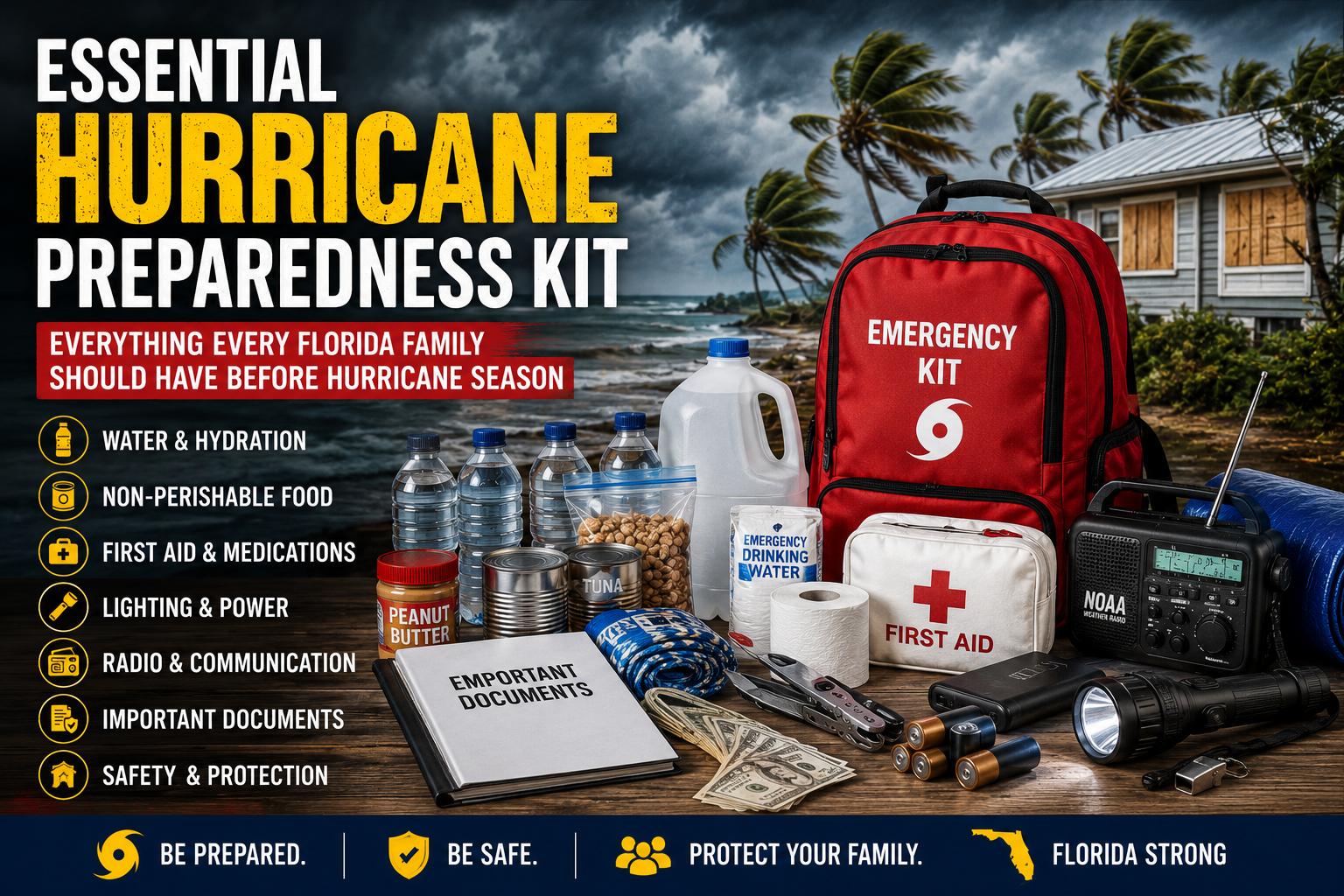
Introduction
Ask any longtime Florida resident about their worst hurricane experience, and you’ll usually hear the same detail somewhere in the story: they ran out of something. Not water entirely, but enough for the whole week. Not batteries, but the right size. Not food, but anything a picky toddler would actually eat. A hurricane rarely catches Florida completely off guard the forecasts give days of warning but a poorly stocked kit can still turn a manageable storm into a genuinely stressful week.
A proper hurricane preparedness kit solves that problem before it starts. This isn’t a list copied from a national FEMA pamphlet and lightly reworded. It’s built around what actually happens during Florida hurricane season: extended power outages, water system disruptions, road closures that delay restocking, and the specific humidity and heat that make sheltering without AC genuinely miserable. Below, you’ll find the full kit checklist, a supply list organized by category, guidance for different household types, and a comparison of kit sizes so you can figure out exactly what your family needs before the next storm forms.
Table of Contents
- What Makes a Hurricane Preparedness Kit Different From a Regular Emergency Kit
- Complete Hurricane Preparedness Kit Checklist
- Essential Emergency Supplies List by Category
- Family Preparedness Guide
- Hurricane Kit Comparison Table
- Expert Tips for Hurricane Readiness
- Common Mistakes to Avoid
- Frequently Asked Questions
- Conclusion & Next Steps
What Makes a Hurricane Preparedness Kit Different From a Regular Emergency Kit
General emergency kits are often built around a 72-hour window, which works fine for a lot of disasters a wildfire evacuation, a short-term grid failure, a localized flood. Hurricanes don’t follow that timeline. Major storms have knocked out power across parts of Florida for a week to two weeks at a stretch, and road damage or fuel shortages can delay store restocking even longer.
That’s why a real hurricane emergency kit is built around seven to fourteen days of self-sufficiency, not three. It also needs to account for Florida-specific conditions: heat and humidity that make dehydration a faster risk than in cooler climates, storm surge zones where flooding compounds wind damage, and a hurricane season that runs six full months, meaning your kit needs to survive sitting in a closet without degrading long before you ever use it.
Complete Hurricane Preparedness Kit Checklist
Water and Hydration
- 1 gallon of water per person, per day, for at least 7 days
- Portable water filter or purification tablets as backup
- Electrolyte packets or sports drink powder for heat and humidity
Food and Nutrition
- 7-day supply of non-perishable, no-cook or easy-prep food per person
- Manual can opener
- Paper plates, plastic utensils, and a small trash bag supply to conserve water otherwise used for washing dishes
Power, Light, and Communication
- Battery or hand-crank NOAA weather radio
- Flashlights or headlamps with spare batteries
- Portable power bank, fully charged and stored with the kit
- Solar charger as backup for extended outages
Safety and Medical
- Trauma-ready first aid kit
- 7 to 14-day supply of prescription medications
- N95 masks for post-storm debris and mold exposure
- Insect repellent, since standing water after a storm brings a sharp rise in mosquito activity
Documents and Financial
- Waterproof folder with IDs, insurance policies, and medical records
- Cash in small bills
- Printed emergency contact list, including one out-of-state contact
Home and Property Protection
- Pre-cut plywood or hurricane shutters, labeled by window
- Tarps and heavy-duty contractor bags for temporary roof or window repair
- Rope or bungee cords to secure loose outdoor items
Comfort and Sanitation
- Wet wipes, hand sanitizer, and travel-size toiletries
- Change of clothes and sturdy closed-toe shoes per person
- Battery-powered fan, since AC loss during Florida summer heat is a serious comfort and health issue, not just an inconvenience
Essential Emergency Supplies List by Category
Beyond the core checklist, a few categories deserve extra attention because they’re easy to overlook until you actually need them.
Cooling and heat management. Florida hurricanes hit during the hottest months of the year, and losing air conditioning for a week in August is a genuine health risk, especially for infants, elderly family members, and anyone with a chronic condition. Battery-powered fans, cooling towels, and extra water for hydration belong in every kit, not just the “nice to have” pile.
Mold and moisture control. Post-storm flooding and humidity create fast mold growth. A few basic supplies plastic sheeting, a small supply of bleach, and heavy-duty gloves make early cleanup safer and prevent bigger problems later.
Backup cooking method. A small camp stove or butane burner lets you prepare hot food safely without opening a gas grill indoors, which carries serious carbon monoxide risk.
Pet-specific supplies. A week of food, any medications, a secure carrier, and vaccination records. Many post-storm shelters and hotels require proof of vaccination before accepting animals.
Family Preparedness Guide
Every household is different, and a strong hurricane preparedness checklist should flex around your specific family, not the other way around.
- Families with infants: Pack extra formula or baby food, a larger diaper supply than you think you’ll need, and a battery-powered or manual bottle warmer alternative since power may be out for feeding schedules.
- Households with elderly members: Confirm mobility equipment is charged or has backup power, and register in advance for county special needs shelter assistance if medical support may be required.
- Homes with chronic medical conditions: Insulin, oxygen equipment, and other temperature-sensitive medications need a cooling plan a small 12-volt cooler that runs off a car battery can be a genuine lifesaver during extended outages.
- Multi-generational households: Assign specific supply categories to specific adults so nothing gets duplicated or missed one person handles water and food, another handles documents and medications, for example.
- Renters and apartment dwellers: Confirm your building’s hurricane policy in advance, including whether you’re expected to evacuate regardless of floor level, and keep your kit portable since you may not have a garage or shed for bulk storage.
- Pet owners: Build the pet kit alongside the human one, not as an afterthought, since evacuation decisions often hinge on where pets can legally go.
Hurricane Kit Comparison Table
| Kit Type | Duration | Best For | Key Additions |
|---|---|---|---|
| Basic Hurricane Kit | 3–5 days | Inland areas, lower-risk storms | Water, food, flashlight, first aid |
| Standard Family Kit | 7 days | Most Florida households | Full supply list, cooling gear, documents |
| Extended Storm Kit | 10–14 days | Coastal zones, major storm forecasts | Larger water reserve, generator, backup cooking |
| Evacuation Go-Bag | 3 days, portable | Households in evacuation zones | Lightweight version of core supplies, easy to carry |
Most Florida families are best served by the Standard Family Kit as their baseline, with an Evacuation Go-Bag built alongside it in case an evacuation order comes down. Coastal households or anyone expecting a major storm should lean toward the Extended Storm Kit instead.
Expert Tips for Hurricane Readiness
- Buy supplies in the off-season. Prices are lower and shelves are full in January compared to the panic-buying that hits every June through November.
- Store your kit somewhere accessible, not just somewhere available. A kit stuffed in the back of a garage behind holiday decorations wastes precious time when a storm is 48 hours out.
- Freeze water bottles ahead of a forecasted storm. They double as ice packs for your cooler and drinking water as they melt, solving two problems at once.
- Test your generator and radio before hurricane season starts, not after a watch is issued. Equipment that’s been sitting unused for a year is a real gamble.
- Keep a physical, printed copy of your plan. Phones die, and a laminated card with contacts, meeting points, and evacuation routes doesn’t depend on battery life.
- Rotate your kit twice a year. Check it at the start of hurricane season in May or June, and again in December, so nothing has quietly expired mid-season.
Common Mistakes to Avoid
- Assuming a 72-hour kit is enough. Florida hurricanes routinely cause outages lasting a week or longer; a short-duration kit leaves families scrambling by day four.
- Forgetting cooling and heat management. Water and food get the attention, but losing AC during a Florida summer is a real safety issue that’s easy to overlook until it’s 95 degrees indoors.
- Waiting until a storm enters the forecast to shop. Water, batteries, and generators sell out fast once a system is being tracked, often within 24 to 48 hours of media coverage starting.
- Storing perishable supplies without a rotation plan. Batteries corrode, food expires, and medications lose potency an unchecked kit isn’t a reliable one.
- Overlooking mold and moisture risks. Post-storm cleanup without gloves, plastic sheeting, or basic mold prevention supplies can create a second, slower-moving health problem.
- Building one kit for the whole family instead of scaling it. A single bag doesn’t work well for a household of six split supplies logically so no one category runs out because of demand from too many people at once.
Frequently Asked Questions
1. What’s the difference between a hurricane preparedness kit and a hurricane emergency kit? The terms are often used interchangeably, but a hurricane preparedness kit typically refers to the full home setup covering seven or more days, while a hurricane emergency kit can also describe a smaller, portable version meant for quick evacuation.
2. How many days should a hurricane preparedness kit cover? Most experts recommend at least seven days for a standard Florida household, with coastal areas or households expecting a major storm extending that to ten to fourteen days given the risk of longer outages and delayed relief.
3. What size water supply do I need for a hurricane preparedness kit? Plan for one gallon per person, per day, for at least seven days that’s 28 gallons for a family of four. Combine stored water with a portable filter as backup in case of contamination.
4. When is the best time to buy hurricane supplies? Before hurricane season begins in June, ideally during the off-season from December through May, when prices are lower and stock is reliably available. Waiting until a storm is already in the forecast usually means shortages.
5. Do I need a generator as part of my hurricane supplies? It’s not mandatory, but it makes a significant difference for households with medical equipment, refrigerated medication, or anyone especially vulnerable to extended heat exposure. If used, generators should always run outdoors and away from windows or doors.
6. How is a hurricane survival kit different for coastal versus inland households? Coastal households generally need a larger kit accounting for storm surge evacuation and longer restoration timelines, while inland households may be able to rely on a shorter-duration kit unless a major storm is specifically forecast for their area.
7. What’s often missing from store-bought hurricane kits? Pre-packaged kits frequently skip cooling supplies, a full seven-day water plan, and documentation storage. It’s worth checking contents against a full checklist and adding anything missing rather than assuming a store-bought kit is complete as-is.
8. How often should I check and restock my hurricane kit? Twice a year is the general recommendation once at the start of hurricane season in May or June, and again toward the end of the season or in December, to replace anything expired or used.
Conclusion
A hurricane preparedness kit isn’t just a box of supplies in the garage it’s the difference between riding out a storm calmly and spending a stressful week improvising. Building yours around a full seven-to-fourteen-day window, accounting for Florida’s specific heat and flooding risks, and customizing it for your household’s actual needs turns “we should probably prepare” into a plan you can trust. Check it twice a year, keep it accessible, and you’ll be ready long before the next storm ever forms in the tropics.
Ready to get your household truly storm-ready? Explore FloridaStormSupply’s full range of hurricane emergency kits and hurricane survival kits, built around a complete hurricane preparedness checklist and matched to the emergency kit for hurricane season your household actually needs, along with dedicated storm emergency supplies for home protection and cleanup. Don’t wait for the next tropical wave to start preparing shop FloridaStormSupply.com today and build a kit your family can count on.