
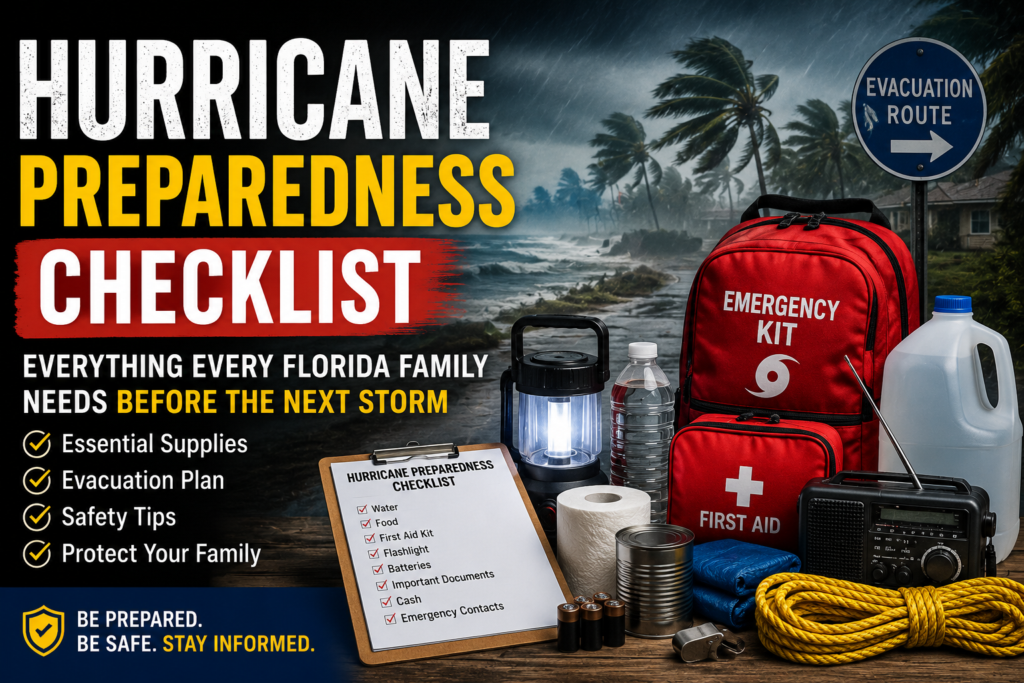
Introduction
If you’ve lived in Florida for more than a season or two, you already know the drill: a tropical wave forms off the coast of Africa, the cone of uncertainty starts creeping across your local news, and suddenly every gas station line in town is four cars deep. Hurricane season runs from June through November, and for millions of Florida households, that six-month stretch means living with one eye on the tropics.
The families who ride out storms with the least stress aren’t the ones who panic-buy plywood two days before landfall. They’re the ones who built their hurricane preparedness checklist months earlier, tested their supplies, and know exactly what to do the moment a watch turns into a warning. This guide walks through that entire process from assembling a proper hurricane emergency kit to planning an evacuation route to knowing what to do in the hours after the storm passes. It’s built specifically for Florida conditions, not a generic national checklist repackaged with palm trees on the cover.
Table of Contents
- Why a Hurricane Preparedness Checklist Matters in Florida
- Step-by-Step Hurricane Preparedness Checklist
- Family Emergency Planning Checklist
- Emergency Supply Checklist Table
- Evacuation Planning Guide
- Hurricane Safety Tips: Before, During, and After the Storm
- Common Mistakes to Avoid
- Frequently Asked Questions
- Conclusion & Next Steps
Why a Hurricane Preparedness Checklist Matters in Florida
Florida sees more hurricane landfalls than any other US state, and the risks extend well beyond wind damage. Storm surge, inland flooding, tornadoes spun off from the outer bands, and extended power outages all factor into the real threat picture. NOAA’s Hurricane Center has noted that storm intensification has become faster and less predictable in recent years, which means the “we’ll wait and see” approach that used to work for some families is riskier than it used to be.
A checklist isn’t about fear it’s about removing decisions from a moment when you’ll have very little time to make them calmly. When a storm strengthens 24 hours before landfall, you don’t want to be figuring out where your flashlights are. You want to already be watching the forecast, kit packed, plan set.
Step-by-Step Hurricane Preparedness Checklist
Step 1: Know Your Evacuation Zone
Every coastal and low-lying Florida county has designated evacuation zones, and they’re not the same as flood zones. Look yours up through your county’s emergency management website before hurricane season starts, not while a storm is approaching. This single piece of information shapes almost every other decision on this list.
Step 2: Build Your Core Hurricane Emergency Kit
At minimum, your kit should sustain your household for seven days, since Florida’s size and storm-track unpredictability can mean longer outages and delayed relief than a standard 72-hour kit accounts for. This is where a dedicated hurricane emergency kit built specifically for extended outages rather than a generic go-bag makes a real difference.
Step 3: Secure Emergency Water Storage
Plan for one gallon of water per person, per day, for at least seven days. That’s 7 gallons per person, or 28 gallons for a family of four. Combine stored water with a portable filter as backup in case storm surge or contamination affects your tap water after the storm.
Step 4: Stock Non-Perishable Food
Choose shelf-stable items that don’t require refrigeration or extensive cooking, since power outages after a major hurricane commonly last anywhere from several days to two weeks. Canned proteins, peanut butter, granola bars, and freeze-dried meals are reliable staples.
Step 5: Prepare Your Home
Trim trees and shrubs well before storm season, know how to shut off utilities, and have hurricane shutters or plywood cut to size and labeled for each window ahead of time. Trying to measure and cut plywood the day before landfall is a common, avoidable scramble.
Step 6: Gather Documents and Financial Backup
Keep insurance policies, IDs, medical records, and a home inventory (photos help) in a waterproof, portable folder. Add cash in small bills, since ATMs and card readers often go down along with the power.
Step 7: Charge and Pack Power Sources
A portable power bank, a solar charger, and extra batteries for radios and flashlights matter more than people expect. Cell service can become spotty for days, and a charged phone is often your best line of communication and information.
Step 8: Review Your Plan With the Whole Household
Walk through the plan out loud with everyone in the home, including where you’ll go if you evacuate, how you’ll communicate if separated, and where supplies are stored. A plan that lives only in one person’s head isn’t a real plan.
Family Emergency Planning Checklist
Every household has details a general checklist won’t cover. Build these into your plan directly:
- Out-of-area contact: Choose one relative or friend outside Florida everyone can call if local lines are jammed
- Meeting points: Pick a primary and backup location in case you’re separated during evacuation
- Medical needs: List prescriptions, dosages, and prescribing doctors for every family member
- Infants and young children: Diapers, formula, comfort items, and a lightweight version of the family kit sized for them
- Elderly or mobility-limited family members: Confirm transportation and any special equipment needs well ahead of a storm
- Pets: Food, medication, carriers, and a recent photo many shelters require proof of vaccination, so keep records with your documents
- Special needs registry: Florida counties offer special needs shelter registration for residents requiring medical support during evacuation; register before hurricane season, not during it
Emergency Supply Checklist Table
| Category | Item | Recommended Quantity |
|---|---|---|
| Water | Stored water + portable filter | 1 gal/person/day x 7 days |
| Food | Non-perishable, no-cook meals | 7-day supply per person |
| Power | Batteries, power bank, solar charger | Enough for 7+ days |
| Light | Flashlights, headlamps | 1 per family member |
| Communication | NOAA weather radio | 1 per household |
| First Aid | Trauma-ready first aid kit | 1 per household |
| Medications | Prescription rotation supply | 7-day minimum |
| Documents | IDs, insurance, cash | 1 waterproof folder |
| Home Prep | Plywood/shutters, tarps, sandbags | Sized to your home |
| Sanitation | Wipes, hand sanitizer, garbage bags | 1 set per person |
| Tools | Multi-tool, manual can opener | 1 per kit |
| Pets | Food, carrier, medication, records | 7-day supply |
Evacuation Planning Guide
Know Before the Storm
Decide in advance whether you’re a “stay” or “go” household based on your evacuation zone and home’s construction. Mobile homes and homes in storm surge zones should plan to evacuate regardless of storm category once an order is issued.
Map Multiple Routes
Interstate evacuation routes fill quickly. Identify at least two possible routes out of your area, and know that contraflow (reversed highway lanes) may be activated for major storms check your county’s emergency management updates for activation status.
Time Your Departure
Leave as early as possible once an evacuation order is issued for your zone. Waiting until the last day typically means hours of gridlock, and outer bands with tropical-storm-force winds can arrive well before the storm’s center makes landfall.
Pack the Right Kit
Your evacuation kit should be lighter and more portable than your full home hurricane preparedness kit. Prioritize documents, medications, a few days of food and water, phone chargers, and basic first aid this is where a purpose-built hurricane survival kit designed for mobility saves valuable prep time.
Confirm Where You’re Going
Have a destination in mind before you leave a relative’s home outside the impact zone, a hotel with confirmed availability, or a designated shelter. Arriving somewhere with no plan wastes time you may not have.
Hurricane Safety Tips: Before, During, and After the Storm
Before the Storm
- Fill your car’s gas tank as soon as a storm enters the forecast, not the day before landfall
- Freeze water in containers to keep refrigerated food cold longer during outages
- Bring in or secure outdoor furniture, grills, and anything that could become airborne debris
- Charge all electronics and power banks fully
During the Storm
- Stay away from windows, even with shutters installed, and shelter in an interior room on the lowest safe floor
- Never go outside during the eye of the storm thinking it has passed the second half often brings equally dangerous winds from the opposite direction
- Avoid using candles for light due to fire risk; rely on battery or crank-powered light sources instead
- Monitor your NOAA weather radio for updates, since cell service often degrades during peak storm conditions
After the Storm
- Wait for an official “all clear” before going outside, even if conditions look calm
- Avoid floodwater it can hide downed power lines, sharp debris, and contamination
- Photograph any home damage before cleanup for insurance purposes
- Check on elderly or vulnerable neighbors once it’s safe to do so
- Run generators only outdoors, at least 20 feet from windows and doors, to prevent carbon monoxide poisoning
Common Mistakes to Avoid
- Waiting until a storm is in the forecast to start preparing. Shelves empty fast once a storm enters the five-day cone, and supplies bought under pressure are often incomplete.
- Underestimating outage length. Major hurricanes have caused outages lasting one to two weeks in parts of Florida; a 3-day supply isn’t enough for hurricane season specifically.
- Forgetting to test generators and radios before storm season. Equipment that hasn’t been run in a year is a gamble at the worst possible time.
- Ignoring storm surge risk because “it’s just a Category 1.” Storm surge and flooding, not wind speed alone, cause the majority of hurricane-related deaths.
- Not registering for special needs shelter assistance in advance. This process typically can’t be completed once a storm is already approaching.
- Skipping a documented home inventory. Photos and records taken before a storm make insurance claims significantly faster and smoother afterward.
Frequently Asked Questions
1. What should be in a basic hurricane preparedness checklist? At minimum: a 7-day water and food supply, a first aid kit, flashlights and batteries, a NOAA weather radio, medications, important documents in a waterproof folder, cash, and a plan for pets and vulnerable family members.
2. How much water should I store for hurricane season? Plan for one gallon per person, per day, for at least seven days, since Florida hurricanes can cause outages lasting well beyond the standard 72-hour emergency window used for most other disasters.
3. When should I start preparing my hurricane emergency kit? Ideally before hurricane season begins in June. Waiting until a storm is in the forecast usually means shortages on essentials like water, batteries, and plywood, along with longer lines and higher prices.
4. How is a hurricane preparedness kit different from a general emergency kit? A hurricane preparedness kit is built for Florida’s specific risks extended power outages, storm surge, and flooding and typically covers a full week or more of supplies, compared to the standard 72-hour kit used for shorter disruptions.
5. Should I evacuate for every hurricane? Not necessarily. Evacuation decisions depend on your specific evacuation zone, home construction, and the storm’s projected surge and wind impact not just its category. Check your county’s zone-specific guidance for each individual storm.
6. What’s the biggest mistake people make with hurricane supplies? Waiting too long to prepare. Once a storm enters the forecast cone, stores often sell out of water, batteries, and generators within a day or two, leaving last-minute shoppers without core supplies.
7. Do I need a generator as part of my hurricane supplies? It’s not strictly required, but it significantly improves comfort and safety during extended outages, especially for households with medical equipment or refrigerated medication needs. If you do use one, always run it outdoors, away from windows and doors.
8. How do I prepare pets for hurricane season? Keep a 7-day supply of food, water, and any medications, along with a secure carrier and updated vaccination records, since many shelters require proof of vaccination before accepting animals.
Conclusion
Hurricane season in Florida isn’t a matter of if but when, and the households that come through it with the least disruption are the ones who prepared before the first storm ever appeared on the radar. A complete hurricane preparedness checklist covering supplies, evacuation planning, and a clear family plan turns a stressful, unpredictable event into something manageable. Build your kit now, review it every season, and make sure everyone in your household knows the plan before you ever need it.
Ready to get your household storm-ready before the next system forms in the tropics? Explore FloridaStormSupply’s full lineup of hurricane emergency kits, hurricane preparedness kits, and hurricane survival kits, including dedicated emergency kits for hurricane season and storm emergency supplies built specifically for Florida conditions. Don’t wait for the cone of uncertainty to point your way shop FloridaStormSupply.com today and get your family ready for whatever this hurricane season brings.